
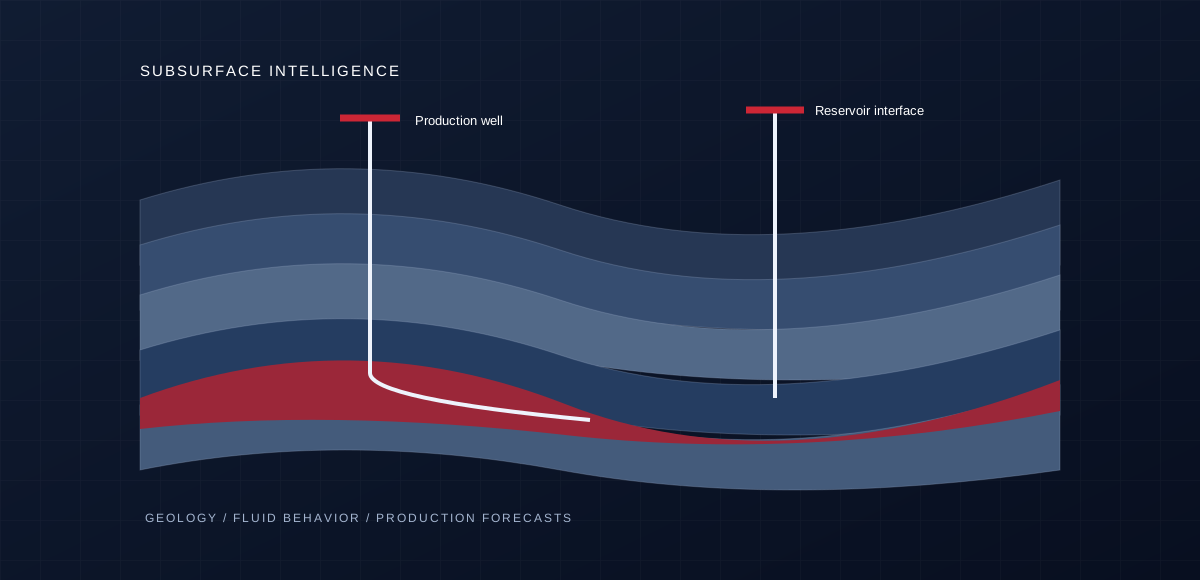
Sound field development begins with a clear understanding of the resource, its uncertainties, and its expected production behavior.
Our subsurface engineering offering is structured to support reservoir evaluation, development planning, production forecasting, and the definition of technical inputs required for surface facilities.
Reservoir Characterization & Modeling
Build a Defensible Representation of the Resource.
Reservoir characterization integrates available geological, geophysical, petrophysical, and engineering data to evaluate reservoir architecture, fluid distribution, connectivity, and resource potential.
Depending on the project scope, activities may include:
- Geological and petrophysical data integration.
- Seismic interpretation and structural assessment.
- Reservoir property modeling.
- Hydrocarbon volumetric evaluation.
- Static and dynamic reservoir modeling.
- Sensitivity analysis and uncertainty assessment.
These evaluations provide the technical foundation for understanding reservoir potential and identifying the assumptions that influence development decisions.
Field Development Planning
Translate Reservoir Potential into a Development Strategy.
Field development planning evaluates alternative ways to produce a resource while accounting for reservoir performance, technical constraints, infrastructure requirements, and project objectives.
Our proposed scope may include:
- Well count and well placement evaluations.
- Production plateau and decline strategy assessment.
- Development phasing and production scenarios.
- Pressure maintenance and injection strategy evaluation.
- Recovery mechanism assessment.
- Infrastructure and surface facility interface requirements.
- Development scenario comparison and uncertainty analysis.
The objective is to establish a coherent development concept that links reservoir performance with production targets and infrastructure requirements.
Production Forecasting
Anticipate the Conditions the Facilities Must Handle.
Production forecasts provide essential inputs for surface facility design and long-term operational planning.
Depending on available data and the selected modeling approach, forecasting may evaluate:
- Oil, gas, water, and condensate production profiles.
- Reservoir and flowing pressure trends.
- Fluid composition and expected changes over time.
- Production decline and potential liquid loading.
- Compression demand and operating pressure ranges.
- Gas processing and treatment requirements.
- Uncertainty ranges and alternative operating scenarios.
These forecasts help establish the design basis for gathering systems, compression, gas treatment, LNG feed systems, and associated utilities.
Integrated Subsurface-to-Surface Interface
Ensure the Reservoir Model Informs Facility Design.
Subsurface engineering becomes more valuable when its outputs are translated into clear engineering inputs for surface facilities.
Reservoir forecasts and fluid characterization can inform:
- Wellhead and inlet design conditions.
- Gas composition and process specifications.
- Compression staging and equipment operating ranges.
- Gas treatment and separation requirements.
- LNG feed gas availability and variability.
- Production capacity and future expansion scenarios.